October 2026
THE DUKE OF BUCKINGHAM'S GREAT WATER
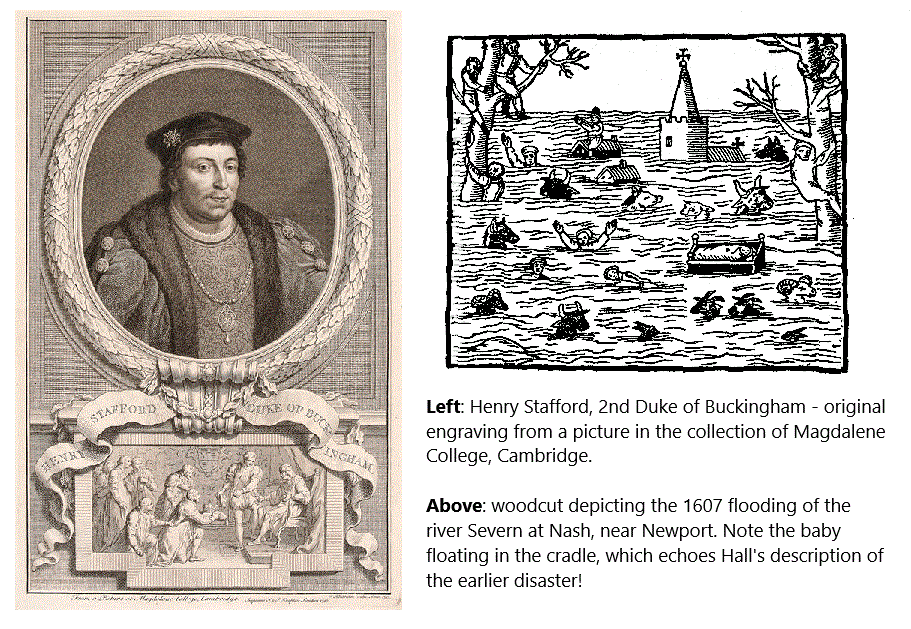
"The duke with all his power marched through the forest of Dean intending to have passed the river of Severn at Gloucester, and thereto have joined in army with the Courtneys and other Western-men of his confederacy and affinity, which if he had done no doubt but king Richard had been in great jeopardy either of privation of his realm or loss of his life or both. But... before he could attain to Severn side, by force of continual rain and moisture, the river rose so high that it overflowed all the country adjoining, insomuch that men were drowned in their beds, houses with the extreme violence were overturned, children were caried about the fields, swimming in cradles, beasts were drowned on hills, which rage of water lasted continually, ten days, insomuch that in the country adjoining they call it to this day, the great water, or the duke of Buckingham's great water;"
Hall also described how the raging torrents washed away every bridge and ford over the Severn, leaving Buckingham and his army stranded without supplies or reinforcements. Such proof of Divine displeasure was too much for the duke's predominantly Welsh troops, many of whom had been pressed into service against their will, and they promptly mutinied.
"By this inundation the passages were so closed that neither the duke could come over Severn to his accomplices, nor they to him, during the which time, the Welshmen lingering idly and without money, victuals, or wages suddenly scaled and departed: and for all the duke's fair promises, menaces and enforcements, they would in no wise neither go farther nor abide. The duke thus abandoned and left almost post alone was of necessity compelled to fly, and in his flight was with this sudden [reversal] of fortune marvellously dismayed:"
Text, with modernised spelling, taken from The Union of the Two Noble and Illustre Families of Lancastre and Yorke (also known as Hall's Chronicle, 1809 edition) p394